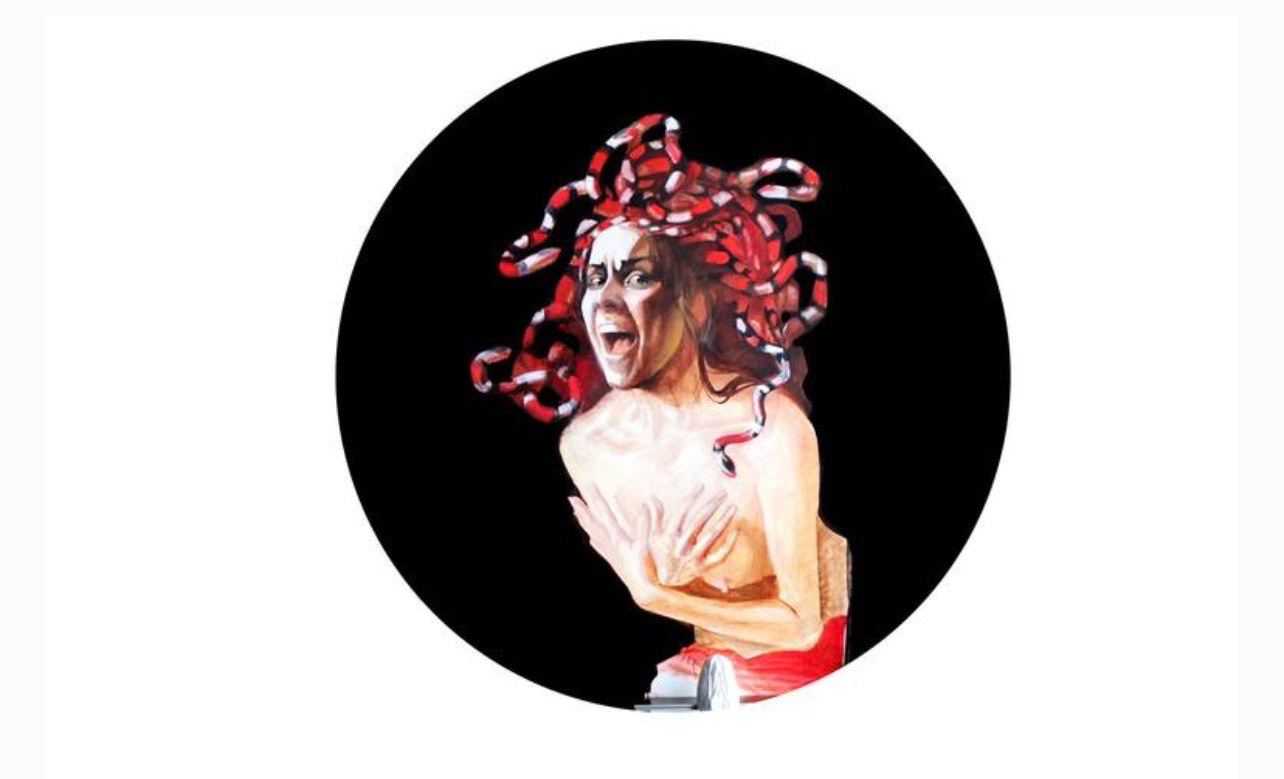
Artist interview with curator Elisabeth Pratt
1. What is the core problem your work addresses?
The body is no longer a stable category. It is continuously rewritten by medical systems, digital imaging, cultural projection, and technological intervention. My work operates inside this instability.
Painting becomes a site where conflicting definitions of the body are forced to coexist without resolution. The aim is not representation but pressure: to hold biological, symbolic, and constructed states in the same field until they break against each other.
2. Why Baroque language as a reference point?
The Baroque is not an aesthetic reference but a structural condition—an image system built under intensity, excess, and collapse of boundaries between spectacle, faith, and matter.
That logic is again relevant, not because we repeat history, but because contemporary visual culture has entered a comparable regime of saturation. Information, biotechnology, and image production now generate similar pressures on perception.
The Baroque is useful only insofar as it describes how meaning behaves under overload.
3. Mortality appears repeatedly in your work. How do you approach it?
Mortality is not treated as subject matter. It is treated as structure.
Contemporary culture simultaneously conceals and aestheticises death through medical imaging, digital abstraction, and controlled visibility. My work engages this contradiction directly: the attempt to produce images where mortality is not symbolised, but materially embedded in how the figure is constructed.
4. What does theatricality mean in your paintings?
Theatre here is not narrative. It is staging as an organisational logic.
It concerns how bodies are positioned, how attention is directed, and how intensity is engineered through composition. Painting becomes a constructed stage where incompatible states—flesh and abstraction, presence and rupture—are held in controlled tension.
5. How does biotechnology inform your visual thinking?
Biotechnology is not referenced as imagery but as condition.
The contemporary body is no longer only experienced directly; it is mediated through scans, diagnostics, data structures, and enhancement systems. This produces a split between lived body and interpreted body.
The work attempts to hold that split visually without resolving it into coherence.
6. Your work is dense and symbolic. How do you avoid aesthetic excess?
Excess is not avoided; it is disciplined.
Symbolic density becomes meaningful only when constrained by internal structure. Repetition, limitation of formal decisions, and series logic prevent the work from dissolving into decoration.
The question is not how much is present in the image, but whether everything present is structurally necessary.
7. What role does painting have in contemporary image culture?
Painting is defined by resistance to acceleration. Unlike digital image systems, it is materially fixed, temporally slow, and resistant to revision after completion.
That resistance produces a different form of attention. The work is not competing with digital images but operating under a different regime of time, labour, and perception.
8. What are you currently trying to resolve?
The current focus is consolidation: reducing conceptual dispersion and tightening the internal logic of the work.
The aim is for the practice to function without relying on explanatory frameworks or biographical scaffolding—where meaning is produced through the coherence of the system itself rather than external narration.